
How Local Service Businesses Get Found in AI Search (2026)
ChatGPT, Google AI Overviews, and Perplexity now answer customer questions directly — without sending users to a results page. Therefore, ranking on Google is no longer enough on its own. This guide explains how service businesses can structure content so AI platforms understand, trust, and recommend them.
AI Search SEO helps service businesses appear in AI-generated answers from ChatGPT, Google AI Overviews, and Perplexity. It combines traditional SEO with GEO (Generative Engine Optimisation) and AEO (Answer Engine Optimisation) to make content easier for AI systems to find, extract, and cite. Service businesses that publish clear, structured answers around real customer questions are most likely to be recommended. The first step is fixing your content structure so AI platforms can understand and act on what you do.
Quick Summary: AI Search SEO for Service Businesses
AI tools like ChatGPT, Google AI Overviews, and Perplexity now deliver direct answers to customer questions. They do not always send users to a list of ranked links. Therefore, ranking on Google is necessary but no longer sufficient.
Service businesses that structure content around real buyer questions — using clear headings, named statistics, and internal links — are more likely to be cited in AI-generated answers. This approach is called AI Search SEO, and it combines traditional SEO with GEO and AEO strategies that work across all major AI platforms.
The businesses most likely to win in AI search are not always the biggest. They are the clearest, most helpful, and best organised. In 2026, that combination matters more than budget or brand size.
What You'll Learn in This Guide
- What AI Search SEO, GEO, and AEO actually mean — and the difference between them
- Why small service businesses can compete with larger brands in AI-generated answers
- What the Princeton GEO Study found — and how to apply it to your content
- Which AI platforms to optimise for and how each one chooses what to cite
- A step-by-step content structure that maximises AI citation potential
- Why businesses in Kampala, Nairobi, Johannesburg and East Africa have a first-mover advantage
- How to measure whether your content is appearing in AI-generated answers
AI Search in 2026 — The Numbers That Matter
What Is AI Search SEO — and Why Does It Matter in 2026?
AI Search SEO is the practice of optimising website content so AI-powered tools — including ChatGPT, Google AI Overviews, and Perplexity — can understand, trust, and cite your business when generating answers for users. It builds on traditional SEO foundations but goes further. Content must be extractable, trustworthy, and clearly structured so AI systems can summarise and recommend it with confidence.
Traditional search put a list of blue links in front of users. However, AI search replaces that list with a single generated answer. Therefore, your goal is no longer just to rank — it is to become one of the three to eight sources AI platforms select when a customer asks a question about your services.
If your website is not structured for AI retrieval, you are invisible to this growing audience. In 2026, that gap compounds quickly. Businesses that appear in AI-generated answers build brand familiarity with buyers who never click a search result.
Building strong AI trust signals that get your business recommended by ChatGPT is the foundation of this entire strategy. Without them, content quality alone is not enough.
The Difference Between SEO, AEO, and GEO
Three terms now define modern search optimisation. Understanding each one helps service businesses build the right strategy.
SEO (Search Engine Optimisation) focuses on ranking in traditional search results through technical health, backlinks, and relevant content. AEO (Answer Engine Optimisation) structures content to appear in Google's featured snippets, AI Overviews, and voice search results — the answer layer above the blue links. GEO (Generative Engine Optimisation) goes further still. It focuses on being cited by large language models like ChatGPT and Claude when they synthesise answers from scratch.
The three disciplines work together, not against each other. Strong SEO creates the foundation. AEO structures content for direct extraction. GEO adds authority signals that make AI systems trust your source over a competitor's. As a result, service businesses need all three operating together in 2026.
| Discipline | Target Platform | Goal | 2026 Priority |
|---|---|---|---|
| SEO | Google, Bing — ranked links | Rank in blue-link results | Foundation — still essential |
| AEO | Google AI Overviews, voice, featured snippets | Be selected as the direct answer | High — answers above the fold |
| GEO | ChatGPT, Claude, Perplexity, Gemini | Be cited in AI-generated answers | Critical — where buyers research |
Why Small Service Businesses Can Compete in AI Search
Small service businesses can compete in AI search because relevance and clarity outperform brand size. AI systems do not automatically favour the biggest organisation. They favour the most helpful, clearest, and best-structured answer. Therefore, a plumber, consultant, contractor, or local agency can compete directly against far larger operators — if their content is more specific, more useful, and better organised.
Large brands produce broad, global content that does not answer local questions well. However, a Kampala-based contractor knows what Ugandan buyers actually ask. A Nairobi consultant understands the specific concerns of East African business owners. That local specificity is a competitive weapon in AI search.
Relevance and Clarity Beat Brand Size
Smaller businesses have a structural advantage in AI search. Their websites have fewer pages, which makes it easier to keep all content tightly focused around one service niche. That focus creates stronger topical authority — and AI systems reward topical authority with higher citation rates.
For example, a bookkeeping firm in Kampala publishing clear answers to tax questions specific to Uganda is more relevant to a Ugandan buyer than a global accounting firm publishing generic advice. Because of this, specificity becomes a measurable ranking factor — not just good writing practice.
What Is GEO (Generative Engine Optimisation)?
GEO, or Generative Engine Optimisation, is the practice of structuring content so that large language models — including ChatGPT, Claude, Gemini, and Perplexity — cite it when generating answers. Unlike traditional SEO, which targets a list of ranked links, GEO targets the synthesised answer itself. The goal is to become one of the sources an AI platform selects when a user asks a relevant question about your services.
GEO does not replace SEO. It builds on it. Technical health, strong backlinks, and clean metadata still matter. However, GEO adds specific content requirements that traditional SEO alone does not address — particularly around citation signals, answer structure, and content authority.
How GEO Works vs Traditional SEO
Traditional SEO asks: "How do I rank higher on Google?" GEO asks a different question: "How do I become the source AI systems cite when they generate an answer?"
The process behind AI search is called Retrieval-Augmented Generation, or RAG. First, the AI retrieves relevant documents from a live web index. Then it synthesises those documents into a single generated answer. Therefore, your content needs to be both findable (traditional SEO) and extractable (GEO). One without the other leaves significant visibility on the table.
What the Princeton GEO Study Found
The Princeton GEO Study — published at ACM SIGKDD 2024 by researchers from Princeton University, IIT Delhi, and Georgia Tech — tested nine content optimisation strategies across 10,000 queries. The results were specific and actionable.
Adding expert quotes improved AI citation visibility by 41%. Including named statistics improved it by 30%. Inline citations — linking to named sources within the text — added a further 30% uplift. Conversely, keyword stuffing reduced citation rates by 9%. The conclusion is clear: AI systems reward content that reads like trustworthy evidence, not promotional copy.
This article is itself a working example of those principles. Five named statistics are cited with their source organisations and publication years. Every H2 section opens with a direct answer sentence — the extraction target AI retrieval systems look for. Named sources — the Princeton Study, DataReportal, OpenAI, Semrush, and Otterly — are referenced inline throughout. That is the multi-source corroboration pattern the study identified as a 30% citation uplift. In other words, reading this guide is not just learning about GEO — you are looking at a page deliberately structured to earn AI citations using the same methods it describes.
What Is AEO (Answer Engine Optimisation)?
AEO, or Answer Engine Optimisation, is the practice of structuring content to appear as the direct answer in AI-powered search features. This includes Google's featured snippets, Google AI Overviews, voice search results, and Bing's direct answer boxes. The core tactic is formatting content so the answer appears first — before supporting explanation — making it easy for AI systems to extract and present without modification.
AEO vs GEO — Which Do You Actually Need?
Most service businesses need both — and the good news is that they share most of the same tactics. AEO focuses on Google's ecosystem: featured snippets, People Also Ask results, and AI Overviews. GEO focuses on standalone AI platforms like ChatGPT, Perplexity, and Claude, which pull content from web indexes and synthesise answers independently.
Because your customers use both Google and standalone AI tools, you need content that satisfies both simultaneously. Answer-first paragraphs, clear headings, and named statistics improve performance in both AEO and GEO environments. Therefore, optimising for one lifts the other at the same time.
Which AI Platforms Should You Optimise For?
Service businesses should prioritise four platforms in 2026: ChatGPT, Google AI Overviews, Perplexity, and Claude or Microsoft Copilot. Each platform uses different retrieval logic and rewards slightly different content signals. Understanding each one helps you structure content more strategically — rather than optimising generically for "AI search."
ChatGPT (OpenAI)
700M+ weekly users. Rewards well-structured, authoritative content with expert quotes and inline citations. Pulls from web indexes via Browse with Bing. Strong topical authority and backlinks support citation rates.
Source: OpenAI usage data, 2025; Surmado AEO/GEO Guide, 2026
Google AI Overviews
Appears in 60% of Google searches. Pulls primarily from top-10 organic results. Optimise for traditional SEO first, then add answer-first paragraphs and FAQPage schema for direct extraction.
Source: Semrush AI Overviews Study, 2025; Jasper GEO & AEO Guide, 2026
Perplexity
Rewards freshness, multi-channel authority, and backlinks. Cites sources visibly in its answers. Therefore, being indexed, having external mentions, and keeping content up to date all directly improve citation rates.
Source: Surmado AEO/GEO Guide, 2026; Starmorph AEO/GEO Traffic Guide, 2026
Claude & Microsoft Copilot
Claude prefers comprehensive, long-form guides with clear structure. Copilot leans on LinkedIn for B2B queries. Both reward content that reads like expert analysis rather than marketing copy.
Source: Surmado AEO/GEO Guide, 2026; Jasper GEO & AEO Guide, 2026
How Do AI Search Engines Choose What to Cite?
AI search engines choose content based on four consistent signals: content clarity, topical authority, trust signals, and retrievable structure. While each platform uses its own algorithms, these patterns appear across ChatGPT, Google AI Overviews, Perplexity, and Claude. Understanding them helps you build content that AI systems want to reference — rather than guessing what might work.
Content Clarity
Content clarity means the answer is easy to find, read, and extract. If the answer is buried behind long introductions, AI systems may skip the page entirely. Therefore, every major section should open with a direct answer sentence. Supporting context, examples, and data follow after — but the answer must come first.
Topical Authority
Topical authority means your website consistently covers a subject area in depth across multiple connected pages. One blog post does not create authority. However, a cluster of related service pages, supporting guides, and FAQs — all internally linked — signals to AI systems that your site is a reliable, comprehensive source on the topic.
For service businesses, this means building content clusters around each core service. A web design agency, for example, should link its web design service page to blogs about AI search visibility, website structure, and lead generation. Our guide to website structure for AI SEO covers exactly how to architect that cluster for maximum citation potential.
Trust Signals and Backlinks
Trust signals include backlinks from relevant sites, brand mentions on third-party platforms, consistent publishing history, and clear author attribution. AI systems use these signals to evaluate whether a source deserves to be cited.
Building quality backlinks remains one of the most effective strategies for both traditional SEO and AI citation visibility. Our guide to building high-quality backlinks in Uganda covers practical approaches for East African service businesses looking to strengthen their authority signals.
Retrievable Structure
Retrievable structure means clean HTML headings (H2, H3), short paragraphs, logical section order, and direct answers near the top of each content block. Well-structured pages are easier for AI systems to parse, summarise, and cite with confidence. Therefore, formatting is no longer cosmetic in 2026 — it is a citation ranking factor.
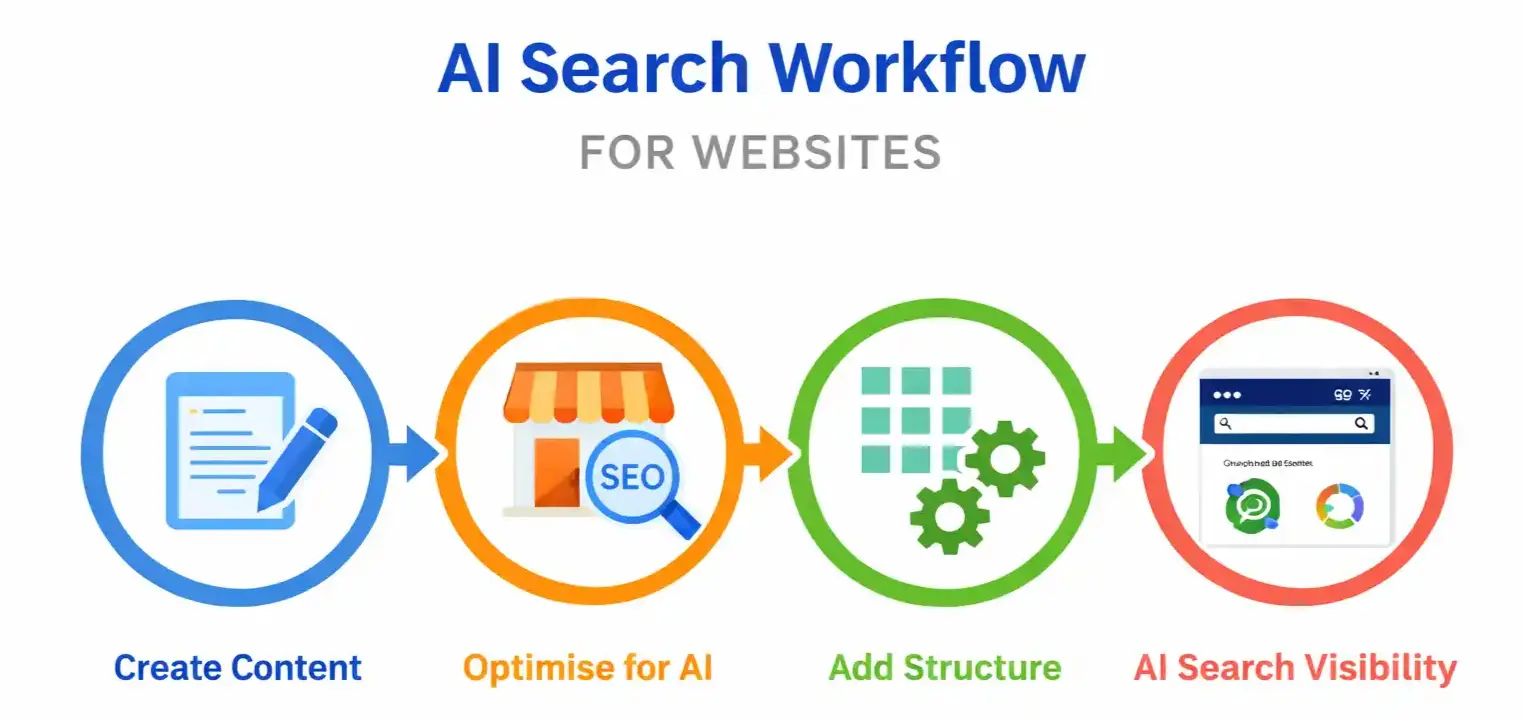
The AI Search SEO workflow: structured content + topical authority + technical SEO = AI citation visibility across ChatGPT, Google AI Overviews, and Perplexity.
How to Structure Your Content for AI Search (Step-by-Step)
Service businesses can structure content for AI search by following one core pattern: answer first, expand second. Every major section should open with a direct sentence that confirms the topic. Supporting context, examples, and data follow. This structure maximises citation extraction potential across ChatGPT, Google AI Overviews, and Perplexity simultaneously — because all three platforms prefer the same retrievable format.
Our Search Engine Optimisation services are built around this exact content architecture — technical health combined with AI-ready structure so your site earns visibility across both traditional and AI-powered search.
Answer First, Expand Second
The single most important habit for AI visibility is to lead with the answer. AI systems use the opening sentence of each section as a retrieval anchor. If the first sentence clearly restates the heading topic, the system can extract and cite that block with confidence. Explanation, examples, and context follow — but the answer must arrive before any preamble.
Build Topic Clusters Around Your Services
Topic clusters group related pages together around a core service theme. For a web design agency, that cluster includes a main service page, a blog on website speed, a guide on AI search visibility, a local page for the city you serve, and an FAQ covering common buyer questions. Internal links connect all of them. Together, they signal topical depth — which AI systems reward with stronger citation rates than isolated pages.
Internal Linking for AI Topical Depth
Internal links help AI retrieval systems understand how your pages relate to each other. When you link from an AI search guide to your SEO service page, you show crawlers and AI systems that these two topics are connected. That connection strengthens topical authority. Always use descriptive anchors — never "click here" or "read more."
Common Mistakes That Kill AI Search Visibility
The most common mistakes that reduce AI search visibility are vague content, slow websites, and thin topic coverage. These issues make pages harder to trust, harder to parse, and less useful than competing sources. AI systems respond by citing a competitor instead. Most of these mistakes are easy to fix once you know what to look for.
- Writing long introductions that delay the actual answer — AI systems skip sections that don't lead with the answer
- Using keyword-heavy headings without a direct answer in the paragraph below — the heading promises what the content does not deliver
- Publishing thin articles with no named statistics, no internal links, and no FAQ — these pages look like filler to AI retrieval systems
- Relying only on social media while neglecting the website — social content cannot be indexed and cited the way web pages can
- Failing to update old content that already has traction — existing pages with authority often earn more from a structure revision than a new article does from scratch
- Writing for algorithms rather than buyers — then packaging it with poor headings and buried answers
- Ignoring schema markup — FAQPage, Article, and Speakable schema give AI systems direct signals about content type and structure
How Do You Measure AI Search Visibility?
AI search visibility is measured through prompt testing, referral traffic analysis, and citation pattern monitoring — not through traditional keyword rankings. Because AI outputs vary with each query, there is no fixed "position" to track. Instead, the goal is to identify patterns: is your content being surfaced? Is your brand being mentioned? Is your site being cited across different platforms and queries?
Manual Prompt Testing
Manual testing means asking ChatGPT, Perplexity, Claude, and Google AI-style queries directly. Use the same language your customers use. Ask "best web design agency in Kampala" or "how do I get more leads from my website in Uganda." Note which sites appear, which brands are mentioned, and which competitors surface consistently. Repeat monthly and track changes over time.
Tracking AI-Referred Traffic in GA4
Google Analytics 4 (GA4) shows referral traffic from AI platforms including chat.openai.com, perplexity.ai, and claude.ai. Set up a channel group for AI-sourced traffic. Track sessions, pages per session, goal completions, and conversion rates from those sources separately. AI-referred traffic typically converts at significantly higher rates than traditional organic. Therefore, even a small share of AI traffic can be highly meaningful for lead generation.
Over time, branded search growth and direct traffic increases are also indirect indicators of AI visibility. When AI platforms mention your business, users often return later through branded search or direct navigation.
Key Takeaways: AI Search SEO for Service Businesses
- AI Search SEO combines traditional SEO with GEO and AEO — all three disciplines are needed in 2026
- Small service businesses can compete in AI search through content specificity and structural clarity
- The Princeton GEO Study proves that expert quotes, named statistics, and inline citations improve AI citation rates significantly
- Answer-first paragraphs under every H2 is the single most impactful formatting habit for AI visibility
- Businesses in Kampala, Nairobi, Dar es Salaam, and Johannesburg have a first-mover advantage in local AI-generated answers
- Manual prompt testing and GA4 AI referral tracking are the most accessible measurement tools available today
- Traditional SEO foundations — technical health, backlinks, internal linking — still underpin all AI citation potential
Conclusion: Get Found in AI Search Before Your Competitors Do
Service businesses that publish clear, structured answers around real buyer questions are best positioned for AI search in 2026. The businesses that win will not always be the biggest or best-funded. They will be the clearest. AI systems reward content that is easy to read, easy to extract, and backed by named sources.
If your website is not yet structured for AI visibility, the gap between you and businesses that are is growing every month. The practical first step is to audit your content structure, add answer-first paragraphs to each major section, and build topic clusters around your core services.
For service businesses in Kampala, East Africa, and beyond, this is a genuine competitive window. Most competitors have not started yet. The businesses that build AI-visible content today will own those answers tomorrow. See WebFast24 pricing and find out how quickly you can have a website that AI platforms understand, trust, and recommend.
Can Ugandan and East African Businesses Rank in AI Search?
Yes — and in many cases, the competitive gap is smaller than it is in Western markets. Service businesses in Uganda, Kenya, Tanzania, South Africa, and across East Africa that publish structured, region-specific content face significantly less competition in AI-generated answers than their counterparts in the UK, USA, or Australia.
Why Local Content Wins in Emerging Markets
AI systems pull from available content. In markets like Uganda, Kenya, Tanzania, and South Africa, there is less structured, high-quality digital content than in Western markets. Therefore, a Kampala contractor, a Nairobi consultant, or a Johannesburg service business that publishes clear, helpful answers to local questions stands out immediately.
Most global competitors write broad, generic advice. However, local buyers search with local context. They ask about pricing in Ugandan shillings or Kenyan shillings. They ask about regulatory requirements specific to their country. They ask about service standards and turnaround times for their market. Content that reflects real local conditions is more useful — and AI systems reward useful content.
According to DataReportal (2025), internet usage across Sub-Saharan Africa continues to grow rapidly, with Uganda's internet penetration exceeding 30% and mobile-first browsing dominant. That means more people searching — and more buyers asking AI tools for local recommendations.
Kampala, Nairobi, Johannesburg — Your AI Search Opportunity
Service businesses in Kampala, Nairobi, Dar es Salaam, Johannesburg, and Cape Town are largely invisible in AI-generated answers today. That is not a problem — it is an advantage for businesses that move first.
Publishing original, locally grounded content means your site can answer questions that no global competitor has addressed properly. As a result, AI systems looking for relevant sources in these markets will have fewer options. Your site can become a go-to regional reference faster than it could in a saturated Western market.
For service businesses in Kampala and East Africa that need a professional website built for AI visibility from day one, our website design for service businesses in Kampala delivers a launch-ready, AI-structured site in 7 days.
Frequently Asked Questions
What is AI Search SEO?
What is the difference between GEO and AEO?
Can a small business compete against larger brands in AI search?
What did the Princeton GEO Study actually find?
How do AI search engines choose which websites to cite?
What is RAG (Retrieval-Augmented Generation)?
Do backlinks still matter for AI search visibility?
How should service businesses in Uganda approach AI search?
How do you measure AI search visibility?
What is the fastest way to improve AI search visibility?
Is Your Website Visible in AI Search?
Get a free 30-minute strategy call. We will audit your AI search visibility and show you exactly what to fix — no obligation.
Or book a strategy call directly — we respond within 1 business day.
No pressure. No obligation. Just a clear plan to help you grow.