
Website Structure · AI Search · 2026 Guide
Website Structure That Gets Your Local Business Found in AI Search
Website structure is now the primary factor that determines whether your local business gets found in AI search. Most local service businesses are invisible to AI tools. Not because of poor service. Because of how their website is built. This guide shows you exactly how to change that.
TL;DR — Quick Answer
AI tools like ChatGPT and Google AI Overviews don't rank websites — they recommend the ones they can read, structure, and trust.
Only 1.2% of local businesses are recommended by ChatGPT, compared to 35.9% appearing in the Google local pack. That gap is structural, not competitive.
Improving your website structure means organising your pages, headings, and content so AI can extract, understand, and cite your business with confidence.
You don't need more content. You need a clearer build.
Quick Summary
Quick Summary: Website Structure That Gets Your Local Business Found in AI Search (2026)
AI tools no longer browse websites the way humans do. They scan for structure, extract meaning, and recommend businesses that are clearly organised and easy to read. For local service businesses in Kampala, Nairobi, and Johannesburg, this is the clearest competitive gap in digital marketing right now.
Most competitors are still optimising for clicks. The businesses that dominate AI search are the ones that organise their websites for extraction. Your website is the only place you fully control what AI says about your business.
When your pages are clearly structured, your services are separated, and your content follows a format AI can cite, you become the answer — not just another result. To understand how AI search has evolved in 2026, read our guide on how local service businesses rank in AI search.
This guide shows you exactly how to build that structure.
WebFast24 Infographic
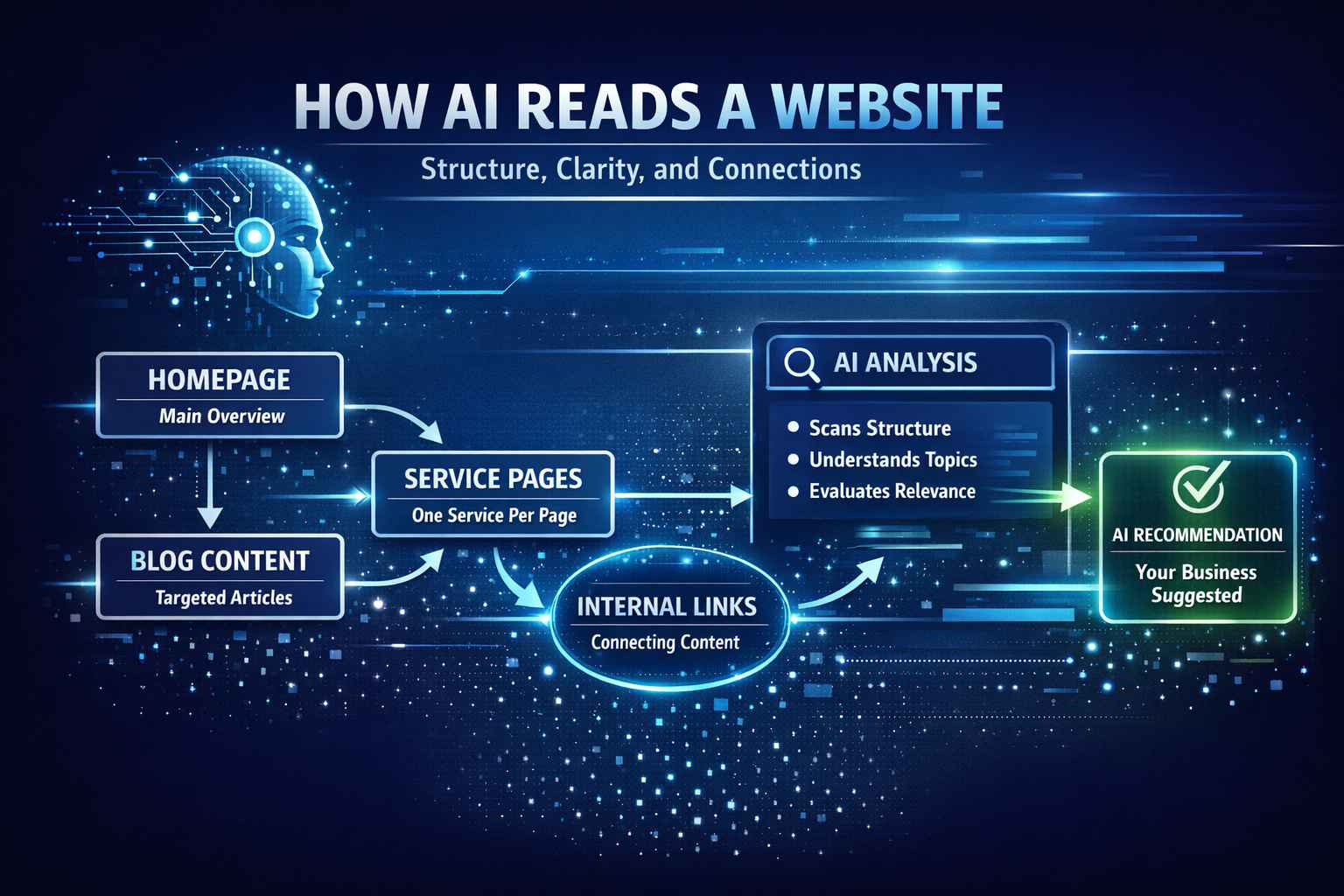
What You'll Learn: Website Structure for Local AI Search
- Why only 1.2% of local businesses get recommended by AI tools — and how to close that gap
- What your website actually looks like to an AI system
- The Island Test — how AI decides which sections are worth citing
- The 5 website structure mistakes that make AI skip your business
- The exact page-by-page structure that improves AI recommendations
- The definition-first method — how to write content AI will extract and cite
- How service businesses in Kampala, Nairobi, and Johannesburg apply this now
What the Research Says About AI Search and Website Structure
Five verified statistics every local service business needs to understand in 2026.
of local business locations are recommended by ChatGPT
SOCi 2026 Local Visibility Index — 350,000+ locations analysed
of all LLM citations come from the first 30% of page content
AirOps Research, April 2026
AI visibility boost from properly structured content
Princeton University & Georgia Tech — GEO Research, 2024
of AI Mode searches end without a click to any website
Semrush, September 2025
improvement in AI citation probability when content includes named statistics
Ziptie.dev Research — via ALM Corp
Why Only 1.2% of Local Businesses Get Recommended by AI Search Tools
Only 1.2% of local business locations are recommended by ChatGPT, compared to 35.9% appearing in the Google local pack. That is a 30-times gap. It is not about service quality or years in business. It is entirely about website structure.
SOCi's 2026 Local Visibility Index analysed over 350,000 business locations across 2,751 brands. The results were unambiguous. Strong performance in traditional local search does not guarantee AI visibility. In retail alone, 55% of brands leading in Google's local pack were completely invisible to AI assistants.
The core problem is how AI tools work. They do not rank websites. They evaluate confidence. An AI assistant recommends a business when it has high confidence in the accuracy, clarity, and structure of that business's information. Businesses with incomplete data, weak heading structures, or unstructured pages fail that confidence threshold entirely.
What AI Tools Actually Recommend — And What They Skip
AI tools look for four structural signals before recommending a local business. They check heading clarity — does the H1 define the page's purpose clearly? They check page separation — does each service have its own dedicated page? They check content extractability — can each section stand alone as a citable answer? They check internal link structure — does the website connect its pages logically?
When any of these signals are weak, AI skips the business. Even if the service is excellent. Even if the reviews are strong. The AI cannot recommend what it cannot confidently read.
Why This Gap Is Even Bigger for Service Businesses in Uganda and East Africa
In Kampala, Nairobi, Dar es Salaam, and Johannesburg, the structural gap is wider than in more saturated markets. Most local competitors still bundle multiple services onto a single page. Most have weak or missing heading hierarchies. Most have no internal linking between their pages. As a result, the competitive bar for AI visibility is far lower here than in the US or UK.
Therefore, service businesses in East and Southern Africa that structure their websites correctly are not just competing locally. They are filling a vacuum that will take most competitors years to recognise.
What Does Your Website Actually Look Like to an AI System?
AI does not read your website the way a human does. It breaks your pages into sections, headings, and entities — then decides whether each piece is clear enough to extract and cite. Your visual design means nothing to this process. Your structural clarity means everything.
Traditional search engines crawled your website for keywords and backlinks. AI systems do something fundamentally different. They interpret meaning. They map relationships between your content. They evaluate whether your pages represent a coherent, trustworthy authority — or an unstructured collection of text.
How AI Breaks Your Pages Into Sections, Headings, and Entities
When an AI crawler visits your website, it reads your HTML structure — not your visual layout. Your H1 is the primary signal for the page's topic. Your H2s define the sub-topics. Your H3s define the supporting details. Each section is evaluated as an independent unit of information.
If your headings are vague — "What We Do", "Our Services", "About Us" — AI cannot extract a clear topic from them. In other words, vague headings equal unclear intent, which equals a page AI cannot confidently recommend. Specific headings like "Website Design for Contractors in Kampala" give AI a clear, extractable signal it can match to a user's query.
The Difference Between a Page AI Can Read and One It Ignores
An AI-readable page has a single, clear purpose. Its H1 defines that purpose precisely. Each H2 section opens with a direct answer to the heading's question. Content is broken into short paragraphs covering one idea at a time. Internal links connect this page to related service pages and blog content.
An AI-ignored page covers multiple topics at once. It uses vague headings. It contains long, unbroken paragraphs that mix different ideas. It has no internal links pointing to related content. For example, a single "Services" page listing ten different offerings gives AI no specific signal to match against any user query. A dedicated page for "SEO Services Kampala" is immediately extractable and citable.
Most importantly, the difference between these two pages is not volume of content. It is structure. And structure is something you can improve on any existing website without starting over.
What Is the Island Test — And Does Your Content Pass It?
The Island Test comes from Generative Engine Optimisation (GEO) research by Princeton University and Georgia Tech. It asks one question about every section of your page: can this section stand alone as a complete, citable answer — without needing the rest of the page for context? Sections that pass the Island Test get cited. Sections that fail get skipped.
This is the most important practical concept in AI search visibility. AI systems do not read your page from top to bottom the way a human does. They break your content into independent chunks — information islands — and evaluate each chunk separately for clarity, completeness, and extractability.
The research from Princeton and Georgia Tech showed that properly structured content — content that passes the Island Test — can improve AI visibility by up to 40%. That is not a marginal gain. That is the difference between being recommended and being invisible.
What Makes a Strong Information Island?
A strong island starts with a direct, standalone answer to the section heading. It does not rely on the sections above it for context. It covers one complete idea. It ends with a clear takeaway that does not require the next section to make sense.
A weak island starts with a vague opening like "As we mentioned above..." or "Building on the previous point...". It references other sections for context. It raises ideas without completing them. It requires the reader — or the AI — to process the whole page before the section becomes meaningful.
How to Test Your Own Content Right Now
Take any section from your website. Copy it into a blank document. Read it in isolation. Does it make complete sense on its own? Does it answer the heading's question directly and completely? If someone read only that section, would they get a useful, complete answer?
If yes, that section is a strong island. If it feels incomplete or confusing without surrounding context, it needs to be restructured. The fix is almost always the same: start the section with a direct answer, then support it with evidence and examples.
The 5 Website Structure Mistakes That Make AI Skip Your Business
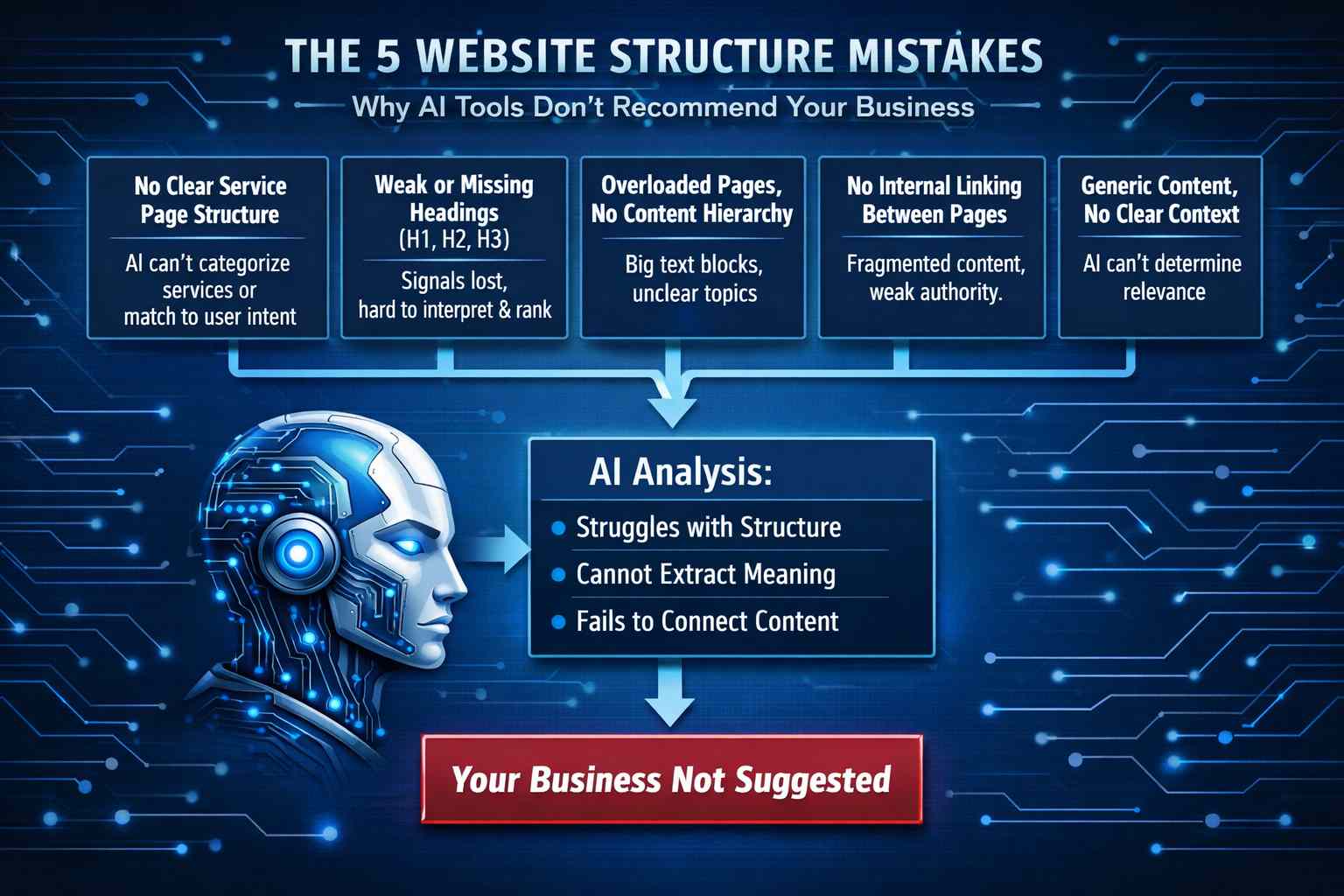
These five structure mistakes prevent AI tools from extracting, understanding, and recommending your business — regardless of how good your service is. Every one of them is fixable without rebuilding your website from scratch.
Mistake 1 — No Dedicated Service Pages
Bundling all services onto a single "Services" page makes it impossible for AI to match your content to a specific user query. When a potential client asks ChatGPT for "website designers in Kampala," AI needs a dedicated, clearly structured page to recommend — not a combined listing.
✓ Fix: One service. One page. One clear intent.Mistake 2 — Weak or Missing H1, H2, H3 Headings
Headings are the primary structural signals AI reads. Vague headings like "What We Do" or "Our Process" give AI nothing to extract. They do not define a topic, a location, or a user intent — which means AI cannot match that content to any query.
✓ Fix: Outcome-first, specific, question-format H2s on every page.Mistake 3 — Overloaded Pages With No Content Hierarchy
Long blocks of text covering multiple ideas in a single paragraph are unextractable. AI needs clear breaks between topics. When your content is a wall of text with no structure, AI treats it as low-quality noise and skips it entirely.
✓ Fix: Short paragraphs. One idea per section. Clear H2/H3 breaks.Mistake 4 — No Internal Linking Between Pages
Internal links are how AI maps your website as a connected system of knowledge. Without them, each page appears isolated. AI may understand an individual page but cannot see how it relates to your other content — which reduces your overall authority and recommendation potential.
✓ Fix: Link service pages to blogs, blogs back to services. Use keyword-rich anchor text.Mistake 5 — Generic Content With No Defined Context
"We provide quality services to businesses across Uganda" tells AI nothing specific. AI needs to know what service, who it's for, where you operate, and what outcome you deliver. Without that specificity, AI cannot confidently classify your content or recommend it for any real query.
✓ Fix: Name your service, your city, your client type, and your outcome in every key section.WebFast24 Infographic
Your Website Is the Only Place You Control What AI Says About You
When AI tools research your business, they pull from multiple sources — reviews, directories, social profiles, and your website. Reviews are written by customers. Directories are managed by third-party platforms. Your website is the only source you fully control. If it is thin, unclear, or unstructured, AI fills the gaps with whatever else it finds.
AI does not fact-check. It aggregates. An outdated directory listing with the wrong address. An old review mentioning a service you no longer offer. A social profile that hasn't been updated in two years. All of this gets used. And your business ends up being described in ways you never intended — or not described at all.
For businesses in Kampala and across East Africa, this is especially relevant. Local directory data is often patchy or inconsistent. Online review volumes are lower than in more digitally mature markets. Google Business Profiles are frequently incomplete.
However, a well-structured website with clear service definitions, accurate location signals, and strong FAQ content becomes the most reliable source AI can find. It becomes your strongest asset for AI citation — because it is the only one you fully own.
This is the framing that changes how you think about your website. It is not just an online brochure. It is not just an SEO asset. It is the document that defines what AI says about you when someone in Kampala, Nairobi, or Johannesburg asks for a recommendation.
Once your structure is in place, the next step is building the AI trust signals that help ChatGPT recommend your business with even greater confidence.
The Exact Page-by-Page Structure That Improves AI Recommendations
The website structure that improves AI recommendations is built around one principle: every page has a single, clear purpose that AI can read, extract, and match to a specific user query. Here is how that principle applies to each type of page on your website.
Homepage — Define What You Do, Who You Serve, and Where
Your homepage is how AI defines your overall business entity. Your H1 must state your service, your location, and your outcome clearly. Avoid broad positioning like "digital solutions for every business." Be specific: "7-day websites for service businesses in Kampala." That creates an entity AI can classify and reference.
Service Pages — One Service, One Page, One Intent
A page titled "Services" covering everything equals a topic AI cannot classify. Separate pages for each service — Website Design, SEO, Social Media, Google Business Profile — each target one specific user intent. This increases your chances of being recommended across multiple queries simultaneously. Explore our approach to conversion-focused website design for service businesses in Kampala.
Blog Content — Building Topical Authority AI Can Trace
Blog posts that link to your service pages reinforce your expertise in that area. AI follows these connections to determine the depth and breadth of your knowledge. Each blog post should answer one specific question completely — making it a strong candidate for AI citation. SEO services for service businesses in Uganda support this structure at the technical level.
Internal Linking — The Connection Layer AI Follows
AI does not evaluate pages in isolation. It follows internal links to map your website as a connected knowledge system. Descriptive anchor text tells AI the relationship between pages. "SEO for service businesses in Kampala" as a link tells AI far more than "click here" — because it defines the topic, the service, and the location in the link itself.
Schema Markup — The Structural Layer AI Reads Directly
Schema markup is structured code added to your pages that tells AI exactly what your content represents — without it having to guess. LocalBusiness schema defines your entity: name, address, phone, services, and location. FAQPage schema gives AI pre-packaged question-and-answer units to extract and cite directly. Article schema confirms authorship and publication date. Pages with schema markup are consistently more likely to appear as AI citation sources. Schema is not a replacement for clear content structure — it is the machine-readable layer that confirms and reinforces your structure to AI systems.
WebFast24 Infographic
The Definition-First Method — How to Write Each Section So AI Cites It
The definition-first method means starting every section with a direct, standalone answer to the heading's question — before any context, explanation, or background. This is the content format AI systems extract and cite most frequently. Sections that bury answers three paragraphs down are far less likely to be used in AI-generated responses.
Traditional writing builds up to the answer. It sets context, explains the problem, and arrives at the conclusion at the end. This works well for human storytelling. However, it does not work for AI extraction. AI scans your content for the most direct, quotable answer to a query. If your answer is buried, AI moves on to a source where it is not.
What Definition-First Means in Plain English
Every section on your page should be written in three layers. First, the direct answer — one or two sentences that fully answer the heading's question. Second, the supporting explanation — two to three sentences that give context or evidence. Third, the practical takeaway — one sentence that tells the reader what to do or remember.
This structure creates an information island that passes the Island Test every time. It is complete, extractable, and citable without any surrounding context.
Before and After — A Service Page Section Rewritten for AI
✗ Before — Not extractable
"At WebFast24, we have been building websites for service businesses in Uganda since 2023. Our team understands the local market and the unique challenges that small businesses face. We use a range of proven strategies that have helped our clients achieve better visibility online and attract more enquiries over time."
✓ After — AI-extractable, definition-first
"WebFast24 builds 7-day websites for service businesses in Kampala that rank on Google and generate leads from day one. We combine fast delivery, local SEO, and conversion-focused design to help Uganda-based businesses get found in both traditional and AI-driven search results. Most clients receive their first qualified enquiry within the first month of launch."
→ The second version is specific, complete, and standalone. AI can extract and cite it directly.Apply this method to every H2 section on your most important service pages. Then check each section against the Island Test. That combination — definition-first writing plus the Island Test check — is the most effective content change you can make for AI visibility.
How Service Businesses in Kampala, Nairobi, and Johannesburg Apply This Now
Service businesses across East and Southern Africa have a structural advantage right now. Most local competitors have weak website structures, inconsistent directory data, and no AI-optimised content. The businesses that act first will dominate AI search in their region before competition catches up.
In Kampala, Uganda
Most local competitors still bundle all services onto one page. Heading structures are weak or generic. Internal linking between pages is rarely implemented. There is no published AI-optimised website structure content from any Uganda-based agency. Therefore, the barrier to AI visibility is lower here than in London, New York, or Sydney. A service business that structures its website correctly in Kampala in 2026 is not competing with established AI-SEO content. It is filling a vacuum.
In Nairobi, Kenya
Kenya leads East Africa in mobile internet penetration and digital adoption. However, the same structural gaps exist. Most Nairobi-based service businesses have combined service pages, no dedicated FAQ content, and minimal internal linking. Strong mobile search usage means the demand for AI-recommended local businesses is growing faster than supply. That gap closes quickly for the businesses that structure correctly now.
In Johannesburg and Cape Town, South Africa
South Africa has slightly more competition than Uganda and Kenya. However, it remains far behind US and UK markets on AI-optimised content structure. Local competitors focus almost entirely on traditional SEO — keyword rankings, backlinks, and Google Ads. The definition-first and Island Test approaches are not yet being applied by South African digital agencies at scale. That is a competitive opening.
The Practical Steps Are the Same Everywhere
Separate your services into dedicated pages. Fix your headings to be specific and question-format. Add internal links between your service pages and your blog content. Rewrite your key sections using the definition-first method. You do not need to outrank global competitors. You need to be the clearest local option AI can find in your city and region.
One More Critical Step — NAP Consistency
NAP stands for Name, Address, and Phone. AI tools cross-reference your website against your Google Business Profile, local directories, and third-party listings. When your business name, address, or phone number is inconsistent across these sources — even small differences like "Rd" vs "Road" or missing a street number — AI loses confidence in your entity accuracy. In East Africa, where directory data is often patchy or outdated, this inconsistency is extremely common. Audit your NAP across every platform before your structure improvements go live. Consistent data is the foundation AI needs to confidently recommend you.
Can You Improve Your Website Structure Without Rebuilding Everything?
Yes. Most businesses already have the content they need. The problem is structure, not volume. Three targeted improvements — better headings, clearer sections, and stronger internal links — can significantly improve how AI reads and cites your website. None of these require a full rebuild.
Start With Headings and Section Clarity
Audit your top five pages. Rewrite every H2 as a clear, question-format, outcome-first heading. Each H2 should make complete sense in isolation — without the page title for context. Then ensure each section opens with a definition-first answer sentence. These two changes improve AI readability immediately.
Fix Internal Links in One Session
Identify your most important service pages and your three most recent blog posts. Add three to five descriptive internal links between them in each direction. Always use keyword-rich anchor text that names the service, the location, or the outcome. Never use "click here" or "read more" as anchor text. This session alone strengthens how AI maps your website.
Align Messaging Across Your Website
AI checks for consistency across all your pages. Your service description on the homepage, the service page, and the blog should use the same terminology and positioning. Inconsistency signals confusion — and AI skips confused sources. A consistent message across pages reinforces your entity definition and increases the likelihood of being recommended across multiple related queries.
If you are unsure where your current website stands, explore our website and lead generation services — we audit structure as part of every strategy call.
Why Traditional SEO Still Matters — But Structure Comes First
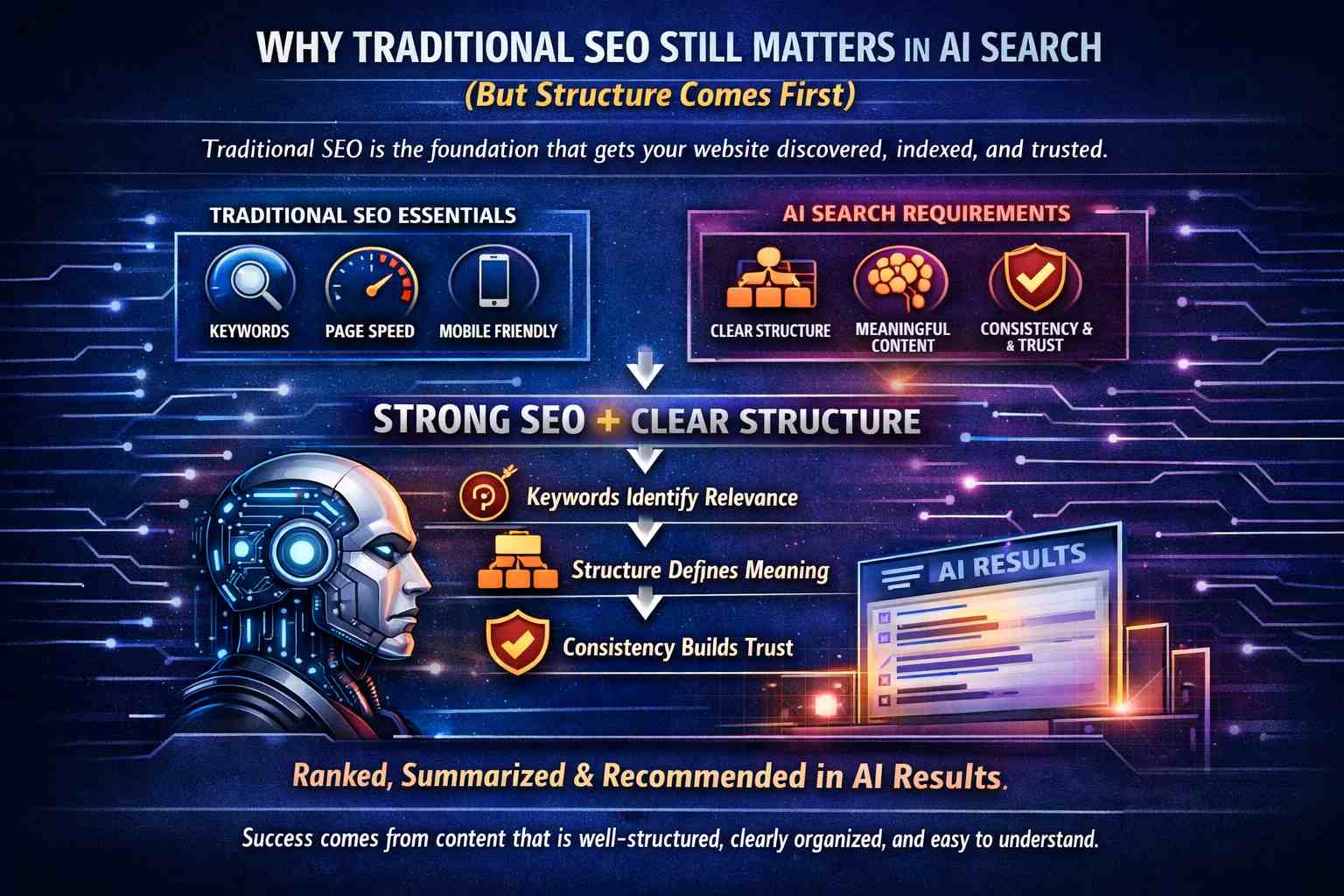
Traditional SEO provides the foundation that gets your website discovered, indexed, and trusted. Without it, AI tools may never find your content in the first place. However, traditional SEO alone is no longer enough. Structure is what determines whether AI recommends you once it finds you.
Keywords, page speed, mobile performance, and backlinks still matter in 2026. They are the conditions that get you into consideration. They signal to search engines that your website is worth crawling and indexing. However, they are the entry point — not the deciding factor.
In AI-driven search, it is not just about ranking. It is about being selected. A page can rank in the top three results and still be skipped by AI if its structure is unclear. Conversely, a page with modest traditional SEO metrics but excellent structure and definition-first content has a strong chance of being cited in AI responses.
Therefore, the businesses winning in AI search in 2026 combine both. Strong SEO fundamentals earn visibility. Clear website structure earns recommendations. Together, they create a compounding advantage that becomes harder for competitors to overcome over time.
If your business is currently not showing up on Google at all, that is a different starting point. Read our guide on why your business is not showing on Google and how to fix it before applying the AI structure improvements in this guide.
Key Takeaways: Website Structure That Gets Your Local Business Found in AI Search
- Only 1.2% of local businesses get recommended by ChatGPT. The gap is structural, not competitive. AI skips businesses it cannot read clearly — regardless of service quality.
- AI reads your website as a collection of independent sections. Each section must be clear enough to stand alone as a complete, citable answer. This is the Island Test — and most local business websites fail it.
- The Island Test is your most powerful quality check. If a section cannot stand alone without surrounding context, restructure it. Strong information islands get cited. Weak ones get skipped.
- The 5 structure mistakes are all fixable. No dedicated service pages, weak headings, overloaded content, no internal links, and generic messaging — every one of them can be corrected without rebuilding your website.
- Your website is the only place you control what AI says about your business. A clearly structured site feeds AI the narrative you want it to use. A thin, generic site leaves AI to fill the gaps from third-party sources.
- The definition-first method is the single most effective writing change for AI visibility. Lead every section with a direct, standalone answer. Then support it. Then close it. That structure passes the Island Test every time.
- Service businesses in Kampala, Nairobi, and Johannesburg have a structural advantage right now. Most local competitors have not optimised for AI search. The businesses that act first will own the space before the competition catches up.
Structure Your Website So AI Tools Find, Understand, and Recommend Your Business
Your website structure is no longer just an SEO consideration. It is the primary factor that determines whether AI tools understand your business well enough to recommend it. The businesses that win in AI search are not the ones with the most content. They are the ones with the clearest structure.
Defined services. Logical headings. Connected pages. Content written in a format AI can extract with confidence. These are not advanced technical changes. They are structural decisions that every local service business can make — and most have not yet made.
For service businesses in Kampala, Nairobi, and Johannesburg, the competitive window is open right now. Most local competitors are still building websites the old way. The market gap is structural. And it is yours to close.
Start with your headings. Fix your service pages. Add internal links. Write definition-first. Then let your website do what it is built to do — generate leads and bookings while you focus on delivering your service.
That is how modern visibility works. It is no longer about being one of many options. It is about being the most understandable and trustworthy option AI can find in your market.
Frequently Asked Questions
Frequently Asked Questions About Website Structure and AI Search
Website Structure That Gets Your Local Business Found in AI Search — Clear, Practical Answers.
What is website structure and why does it matter for AI search?+
Website structure refers to how your pages, headings, content sections, and internal links are organised. In AI search, structure matters because AI tools scan your pages for extractable meaning — not just keywords. A clearly structured website is easier for AI to read, interpret, and recommend in response to user queries. Weak structure means AI skips your business, regardless of how good your service is.
What is the Island Test in AI SEO?+
The Island Test comes from GEO research by Princeton University and Georgia Tech. It asks whether each section of your page can stand alone as a complete, citable answer — without needing context from the rest of the page. Sections that pass the Island Test are more likely to be extracted and cited by AI tools like ChatGPT and Google AI Overviews. Sections that rely on surrounding content for meaning are skipped.
What is GEO and how is it different from traditional SEO?+
GEO stands for Generative Engine Optimisation. It is the practice of structuring your content so that AI tools can extract and cite it in generated answers. Traditional SEO focuses on ranking in search results pages. GEO focuses on being selected and recommended by AI systems like ChatGPT, Google AI Overviews, and Perplexity. Both are necessary in 2026. Traditional SEO gets you found — GEO gets you recommended.
Does website structure affect Google rankings in 2026?+
Yes. Clear page structure — including logical headings, separated service pages, and strong internal linking — improves how search engines crawl and index your content. It also improves how AI Overviews select sources to cite. Website structure directly affects both traditional search rankings and AI visibility. Improving your structure strengthens both simultaneously.
Why do I need separate pages for each service?+
Separate service pages allow AI tools to match each page to a specific user query. When multiple services are bundled onto one page, AI cannot confidently classify your content or recommend it for specific searches. One service per page improves relevance, helps match user intent, and increases your chances of being recommended across multiple different queries simultaneously.
How does internal linking improve AI search recommendations?+
Internal linking helps AI tools understand how your pages connect. When your blogs link to your service pages and your service pages link back to relevant content, AI can map your website as a connected, authoritative system rather than a collection of isolated pages. This increases the likelihood of multiple pages being recommended across related queries — expanding your overall AI search visibility.
What is the definition-first method for writing AI-friendly content?+
The definition-first method means opening every section with a direct, standalone answer to the heading's question — before any background or explanation. AI systems scan for extractable answers. When your answer is the first sentence of a section, it becomes a strong citation candidate. Sections that build up to an answer over several paragraphs are far less likely to be extracted and cited by AI tools.
Can I improve my website structure without rebuilding my site?+
Yes. Most structural improvements come from reorganising existing content — not creating new pages. Updating headings to be specific and question-format, separating service content onto individual pages, adding internal links, and rewriting key sections using the definition-first method can significantly improve AI visibility without a full rebuild. Start with your top five pages and work outward from there.
How do service businesses in Uganda get found in AI search?+
Service businesses in Uganda improve AI search visibility by structuring their websites with clear, dedicated service pages, outcome-first headings, consistent location signals, and definition-first content. Most local competitors have not yet optimised for AI search, which means the competitive gap is currently smaller in Uganda than in more saturated markets. Businesses that implement website structure improvements now will dominate AI recommendations in their region.
What is the first thing I should fix to improve AI visibility?+
Start with your headings. Audit your top five pages and rewrite every H2 as a clear, question-format, outcome-first heading that makes complete sense on its own. Then ensure each section opens with a direct, standalone answer to that heading. These two changes immediately improve how AI reads and extracts your content — and they can be applied to any existing website without technical skills.
GET STARTED TODAY
Ready to Structure Your Website for AI Search?
Book a free 30-minute strategy call. We'll audit your current website structure and map out exactly what needs to change to get your business found in AI search.